


The RS Story
The story of the RS part of the Taunus story is often forgotten, Its told here in more detail by Roy Townsend

The RS Story
During the mid-1960’s, Ford of Germany were regularly being outsold in the Domestic new car market by their main competitors, Opel and Audi, and all were flagging behind the market leader, VW.
A new strategy was required to deal with this tough and competitive market. A strategy that would capture the public’s attention. Therefore, in the Autumn of 1967, the existing P6 model (which had been launched a year earlier) underwent a transformation.
With mechanical upgrades and styling enhancements, a new marketing strategy was planned and the Rallye Sport (RS) was born.
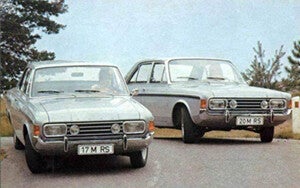
P6 15m RS
The RS was the top of the range model. A car the public would aspire to own, with its body stripes, a revised grill and front spot-lamps.
While the Taunus name has been present on every model since the Second World War, the name was now dropped and the P6 15m RS became a model in its own right.
In early 1968, revisions were made to the P6 15m RS. Trim levels were enhanced, extra instruments were added, and a floor mounted gearstick rounded off the upgrades. The model was relaunched on the 11th March 1968, with the upgrades proving to be a great success. So much so that the P7a range, launched in September 1967 was also offered in RS trim. Hence, during the first part of 1968 Ford of Germany had two RS specification models on sale, the P6 15m RS and the P7a 15m RS.
This addition to the model range generated huge interest in the marque and Ford Sales increased dramatically. The Rallye Sport was now a winning formula and Ford of Germany had exclusive rights to the RS brand. But, as we will see later, this changed with the formation of Ford of Europe.
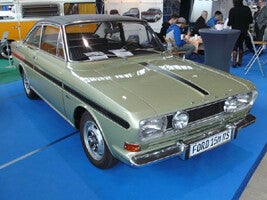
P7A 17m & 20m RS
Unfortunately, the P7a was not as well received by the buying public, although the P7a did receive a similar RS model. Regularly criticized for its Anglo/American styling, with its aptly named cheese grater grille and horizontal, inset, rear lights the P7a was not considered to be aesthetically pleasing. In less than a year, the P7a range was discontinued. Being replaced by the P7b.
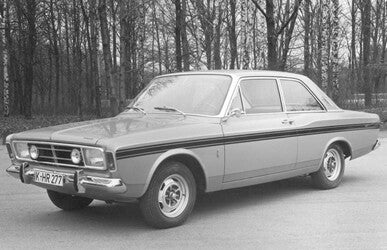
P7B 17m & 20m RS
The P7b still used the same platform as the P7a, but had a much more European look to the styling. Launched in August 1968, the new P7b again received the RS badge and the extras associated with being the top model of the range. Within the space of a year, Ford of Germany had effectively built three different RS variants, albeit with one model discontinued. The P7b RS was available in two guises. The P7b 17m RS and the P7b 20m RS. The 17m having a 2.0L v6 producing 111 bhp and the 20m having a 2.3L v6 with 125bhp. Both engines were derived from the German Cologne units.
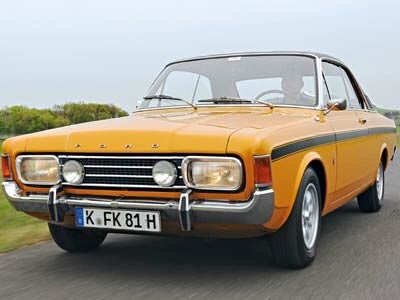
The End of an Icon
Meanwhile in the run-up to 1970, discussions and collaboration had been going on between Ford of Germany and Ford of England, with a view to joining the companies into one giant manufacturing concern, Ford of Europe
It is no coincidence, that on the same day that Ford of Europe was formed, the German rights to the RS badge were also revoked and given to the newly formed Ford of Europe.
On that same day, the 1st January 1970, the 4th generation of the RS was announced.
The South African RS

The Ford plant at Port Elizabeth was designated as the manufacturing site for the South African models, which were all 2-door hardtop coupes, in Right Hand Drive. Production started in 1969 and continued to late 1971, with some of the later built cars being registered in early 1972.
The silhouette of the European and South African cars remained the same, apart from the distinctive bonnet scoop added to the 3.0L RS version. However, side-on differences were notable. Specifically European body stripes were triple layered, "thin-thick-thin" and uniform, whereas the South African counterpart RS cars were much more flamboyant and striking in looks. And a future signature RS look was added. Rallye Stripes! The South African 20m RS was the first to use this stripe format, and it was copied on European RS cars for years to come. There were other subtle differences to the German RS cars. There were just two options available for the South African RS buyer, a radio and a vinyl roof. Visually the differences between the South African 17m and 20m were the 17m had thinner, less distinctive side stripes, while on the 20m the stripes were much broader.
Additionally, the central bonnet area was painted satin black along with the additional bonnet scoop. Both models were easily identifiable from the “lower” models, however. The P7b is considered to be the last true designed Taunus built, with production both in Germany and South Africa ending in December 1971.
The South African P7b production figures are thought to include both the 17m RS and 20m RS models, and during it’s 2.5 year run the figures are:
YEAR NO. OF UNITS
1969 647
1970 371
1971 142
1972 41
In total, the Port Elizabeth plant produced 1,201 RS models, approximately 40 a month over the production run. The production figures are so low that few survive today. But those that do have a cult following and are considered to be mega rare by Ford fans worldwide.

Create Your Own Website With Webador